"You can't come back from wet, you can come back from dry, but not wet." A very good agronomist and trusted consultant, Joel Simmons, gave me this advice last fall. Not only do I believe in this principle, but I think it may be the most important principle with respect to managing low-cut bent-grass through hot/humid conditions.
USGA greens are built on sand so that the green will: (1) drain well; (2) resist compaction and (3) provide a nice balance between air and water porosity. In other words, USGA greens are designed o hold just enough water to achieve field capacity, but not enough water to remain saturated for extended periods.
Saturated soil adversely affects grass by increasing heat retention, reducing gas exchange and most importantly, by minimizing the amount of oxygen that otherwise may reside in the pore space of the profile.
Heat retention occurs because water is denser than air so when it heats up, it stays hotter longer. When wet soil stays hot for an extended period of time, scald occurs. In putting greens, you typically do not see the scald damage at the canopy/crown level because infiltration rates help water get past the surface. However, in profiles that hold moisture, or in areas of greens that remain wet (low-lying areas), the scald occurs within the root-zone. Once the roots go, the leafy tissue above ground is sure to follow suit.
Although scald is a major concern, the deprivation of oxygen may be tantamount to a green's failure/survival during hot/humid stretches of the summer. Oxygen assists the plant in metabolizing food. For example, in the absence of oxygen, the plant struggles to trans-locate magnesium. As an essential component of chlorophyll, the reduction in usable magnesium leads to a decrease in photosynthesis which in turn results in a reduction of structural carbohydrates. Without carbohydrates, the plant can't build parts and decline ensues.
So, between heat retention and the deprivation of oxygen, water management becomes extremely important to the success of bent grass putting greens. Although, irrigation systems have become even more sophisticated, they remain fairly indiscriminate in terms of where water is or is not applied. For example, say that I have a green that stays very dry on the front crown, but very wet in a low-lying swale. Over-head irrigation may be ideal for the dry crown area, but may lead to over-saturation in the back of the green. Going back to the opening quote, "we can always come back from dry." In other words, in this situation, we choose to manage the green with daily hand-watering so that the crown stays hydrated while the low-lying area can dry down properly. In this way, we micro-manage the surface so that no area stays too wet.
This management style is widely adopted by the turf industry and although strides have been made in areas like wetting agents, irrigation control, fans and sub-air, I am not sure we will ever see the day that hand-watering is not an integral part of any successful turf management program.
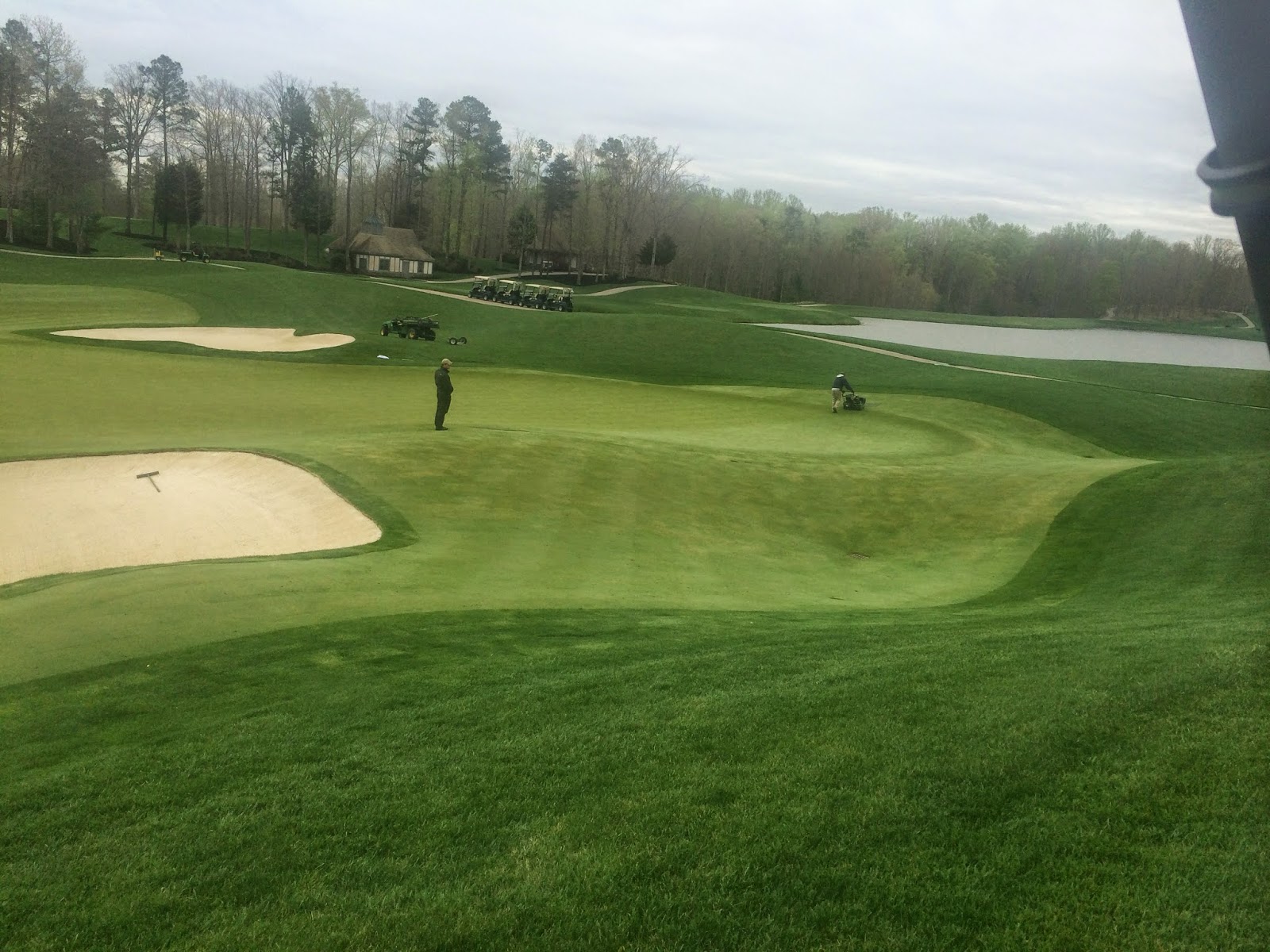
Typically, we spend the morning checking the moisture levels of the greens. We have established thresholds and if the moisture is below those thresholds, we water those specific areas. We prefer the morning hours because the heat of the day isn't on top of us and by mid-afternoon, the applied water has had a chance to drain off. In the afternoon, we check the greens for active wilt and apply water where obvious wilt symptoms are occurring.
The last sentence brings us to the main point of this post. We recognize that employees hand-watering in the middle of the day can be a nuisance. As such, we try very hard to stay out of the way, work in backwards rotations and appreciate the golf experience of every member and guest. However, to maintain the greens as dry as possible, in an attempt to enhance play ability and practice good agronomy, we must hand water throughout the day. It is a necessary evil for the summer months.
Friday, June 19, 2015
Tuesday, May 26, 2015
Bermuda Grass Suppression
Over the next few months, we will be actively spraying common Bermuda Grass that has moved into our desired turf areas. We have common Bermuda infestations in almost every playing surface (fairways, roughs and intermediates) with the exception of our tees and greens. Although these infestations are sporadic and not terribly bad at this point, we must maintain a vigilant herbicide program to not only keep the Bermuda in check, but also to achieve complete eradication.
Up until a few years ago, there were not many herbicide alternatives for Bermuda control in cool-season grasses. Fortunately, a herbicide called Pylex hit the market about 4 years ago. Pylex, which interferes with photosynthesis by disrupting chlorophyll production, will suppress and eventually kill Bermuda that is growing in cool season grass. The rates are extraordinarily low.... for example, in bent grass areas, we are applying Pylex at .5 ounces per acre. That is 1/2 of an ounce over 40,000+ square feet of grass. Nonetheless, this product works very well with minimal downside. The only downside is the aesthetic color of the suppressed Bermuda and surrounding bent.

As you can see in the picture above, because Pylex disrupts chlorophyll, the plant turns white once sprayed. Many times, you cannot even see the Bermuda until we have sprayed it and once the white blotches begin appearing in areas across the property, many members may wonder, "What is going on?"
We can mix another broad leaf herbicide, Turflon, with the Pylex to reduce the whitening. However, half of the battle is to accurately locate the Bermuda infestations, so on our first application, I leave the Turflon out so that the Bermuda is easily located for additional applications.
So, if you begin to notice any white patches across the property, please know that it is our Bermuda grass program kicking off for 2015.
Up until a few years ago, there were not many herbicide alternatives for Bermuda control in cool-season grasses. Fortunately, a herbicide called Pylex hit the market about 4 years ago. Pylex, which interferes with photosynthesis by disrupting chlorophyll production, will suppress and eventually kill Bermuda that is growing in cool season grass. The rates are extraordinarily low.... for example, in bent grass areas, we are applying Pylex at .5 ounces per acre. That is 1/2 of an ounce over 40,000+ square feet of grass. Nonetheless, this product works very well with minimal downside. The only downside is the aesthetic color of the suppressed Bermuda and surrounding bent.
We can mix another broad leaf herbicide, Turflon, with the Pylex to reduce the whitening. However, half of the battle is to accurately locate the Bermuda infestations, so on our first application, I leave the Turflon out so that the Bermuda is easily located for additional applications.
So, if you begin to notice any white patches across the property, please know that it is our Bermuda grass program kicking off for 2015.


Tuesday, April 21, 2015
Spring Project Update
We have had a really nice spring thus far as the grass is waking up and aeration recovery accelerates. We have also returned to our regular maintenance practices, including: mowing, edging, rolling and mulching. In conjunction with our seasonal routine, we have also been busy wrapping up various projects across the golf course.
#11 creek was re-shaped, rocked and grassed to tall fescue on the green's side and fine fescue on the opposite side. The fine fescue has been installed since this photo was taken.



#11 creek was re-shaped, rocked and grassed to tall fescue on the green's side and fine fescue on the opposite side. The fine fescue has been installed since this photo was taken.
An over-grown native area to the front right of the 3rd tee complex was reclaimed and re-grassed to fine fescue.
A 007, bent-grass tee was installed adjacent to the firepit.
The hillside to the left of the 6th fairway was reclaimed and grassed to fine fescue.
A 007, bent-grass tee was re-installed along the dam. Golfers now have a 185 yard tee shot across the pond to the 19th green.
The native area to the left of the 15th fairway was re-installed to fine fescues.
The pond edge near the third green was stripped and re-grassed to low-mow bluegrass. We did this project to remove the bent-grass contamination, but also to enhance the pond view from the landing areas and putting surface. The bluegrass has been installed since this photo was taken.
The tree-line to the left rear of the 4th green was set-back 25 yards to increase sunlight and airflow to the putting surface. In place of the existing tree-line, we installed fine fescues.
The ninth approach was expanded to the right and rear of the green. We installed 007, bent-grass for this project.
The landscape area between the second green and third tee was upgraded and a paved walking path was installed.
We have one last project on the 10th hole and we will re-post upon its completion. I am very proud of our staff for knocking these projects out while also maintaining the course for daily play. I am also thankful for the club support and member patience as we work our way through these improvements.
Tuesday, March 31, 2015

Kinloch Golf Club
1st
Quarter Golf Course Maintenance Update
Although the winter weather has been sporadic, our golf maintenance team has remained very productive. Over the past 3 months, we have accomplished many tasks and projects while maintaining the course for daily play. The following report will cover our production throughout the off-season. We have organized this report into the following sub-sections:
I. Completed Projects
II. Projects Underway
III. Upcoming Projects
IV. Perennial Practices
V. Spring Aeration
VI. Aeration Recovery Time-Line
VII. Detail Work
I. Completed Projects
Under the guidance of our design team, Lester George and Vinny Giles, we have completed several projects across the property.
• Cleaned up and restored the native area to the front right of the 3rd tee complex.
• Removed hardwoods behind the 3rd green.
• Set-back the tree line to the left and rear of the 4th green.
• Restored the native hillside to the left of the 6th fairway (upper)
• Expanded the bent grass approach around the rear and to the right of the 9th green
• Cleared a line of sight to the right lower fairway on the 9th hole
• Converted the first10 yards of the right lower fairway on the 9th hole to rough
• Installed bluestone pathways at porch exits at Cottages 2 and 3
• Re-grassed the par 3 green to new varieties of bent grass
• Re-sodded all collar areas infested with perennial rye-grass
II. Projects Underway
• Install new teeing area to the right of the fire-pit
• New paver path and landscaping to the left of the 2nd green
• New landscaping at the pro-shop entrance
• Restoration of the native area to the left of the 15th tee complex and fairway
• Grading and mulching the gravel access trail behind the 17th green
III. Upcoming Projects
• Reinstate 19th hole teeing area along the dam
• Creek restoration on the 10th hole between the tee complex and fairway
• Creek restoration behind the 11th green
• Paver path way from porch exit at Cottage 1
• Landscaping installations to the left of the 10th green and behind the 15th green
• Landscaping installations along the new patios at all 3 cottages
• Install new irrigation caps on all broken heads (new distance plaques)
IV. Perennial Practices
• Double deep tined fairways and approaches
• Vertical mowed all bent grass surfaces
• Drainage installed in the 3rd and 9th approaches
• Cut-back all over-grown wetland/native areas
• Cleaned up underbrush on the opposite sides of the cart path
• Pruned tree limbs near pocketed green sites (#3,#4,#5,#7,#11,#17)
• Re-furbished all benches, trash cans and other course furniture
• Re-painted all tee marker borders
• Cleaned up all leaves across the entire property
• Fertilized all of our existing plant material
• Planned and ordered all chemicals and fertilizer for 2015
• Removed many dead or dying trees across the property
• Mulched all landscape areas (in progress)
V. Spring Aeration
Our annual spring aeration has gone very well. I remain very thankful for all of the member support that we receive during both the spring and fall aerations. Other than perhaps Member Invitational, there is not a more stressful period(s) than aeration. Although we are very excited about the positive benefits of an aggressive aeration program, there is no one more impatient than our golf maintenance team with regards to recovery time. To keep this report as concise as possible, I would direct you to our blog site for a detailed recap of this year’s aeration process. http://kinlochgcm.blogspot.com/. We look forward to re-opening on Tuesday, March 31st.
VI. Aeration Recovery Time-Line
Once aeration is completed, we immediately focus our attention on the recovery of our playing surfaces; particularly the putting greens. With our process, we apply a great deal of topdressing sand. We do this this for three reasons: (1) to fill all of the aeration holes thus creating clean pore space for months on end; (2) to smooth any imperfections within the putting surface and (3) to firm up the surfaces for the long-term. Although we will remain committed to an aggressive top-dressing program, it does limit our ability to roll the greens directly after we re-open. We do not want to press tender leaf tissue against the grainy sand that has yet to be fully worked into our canopy. Thus, during the first week after reopening, we will single cut the greens each morning with little to no rolling. Beginning with the week of April 6th, we expect that the grass will have grown through the sand to a point where we can re-introduce rolling in conjunction with mowing. Ultimately, we target Master’s Weekend (April 10th – 12th) for consistent putting green performance. This timeline allows for proper post-aeration recovery and dovetails nicely with our opening day celebration. We already feel very fortunate to have such a patient membership regarding our aeration practices. We hope that by explaining our recovery time-line, you can fully appreciate our process and trust that we want to push our surfaces as soon as possible.
VII. Detail Work
A key differentiator in Kinloch’s maintenance practices has always been our strong attention to detail. Nowhere is the commitment more evident than in our care and concern for crisp edges and straight mowing patterns. Following the clean-up from aeration, we will begin edging all of our features while re-marking and straightening any skewed mowing patterns. Throughout the year, we edge every feature on our property every 14 days. However, the first edging of the new season is always the most intensive. Furthermore, we are beginning to mow turf, applying fertilizer and finishing our project list mentioned above. With all of that taken into consideration, our plan for detail work over the coming weeks is as follows:
1. March 30th – April 3rd – Edge Cart Paths/Sod Damaged Edges and Mulch Work
2. April 6th – 10th – Edge Bunkers and Mulch Work
3. April 13th – 17th – Edge Sprinkler Heads and Creek/Pond Banks and Mulch Work
4. April 20th – 24th – Edge Mulch Beds and Complete Mulch Work
Ultimately, our seasonal crescendo is the Member Invitational, but we hope to have most of the detail work completed on our around our Opening Day Celebration.
We hope that you find this report useful. As always, if you have additional questions, feel free to contact me either by phone (804) 840-8320 or email at thedgepeth@kinlochgolfclub.com. You can also access more detailed information on our blog site: http://kinlochgcm.blogspot.com/ and you can see daily course updates on our twitter feed: @kinlochdaily.com. Thank you for reviewing this report and we look forward to a great spring season.
Trevor Hedgepeth
Golf Course Superintendent
Subscribe to:
Posts (Atom)